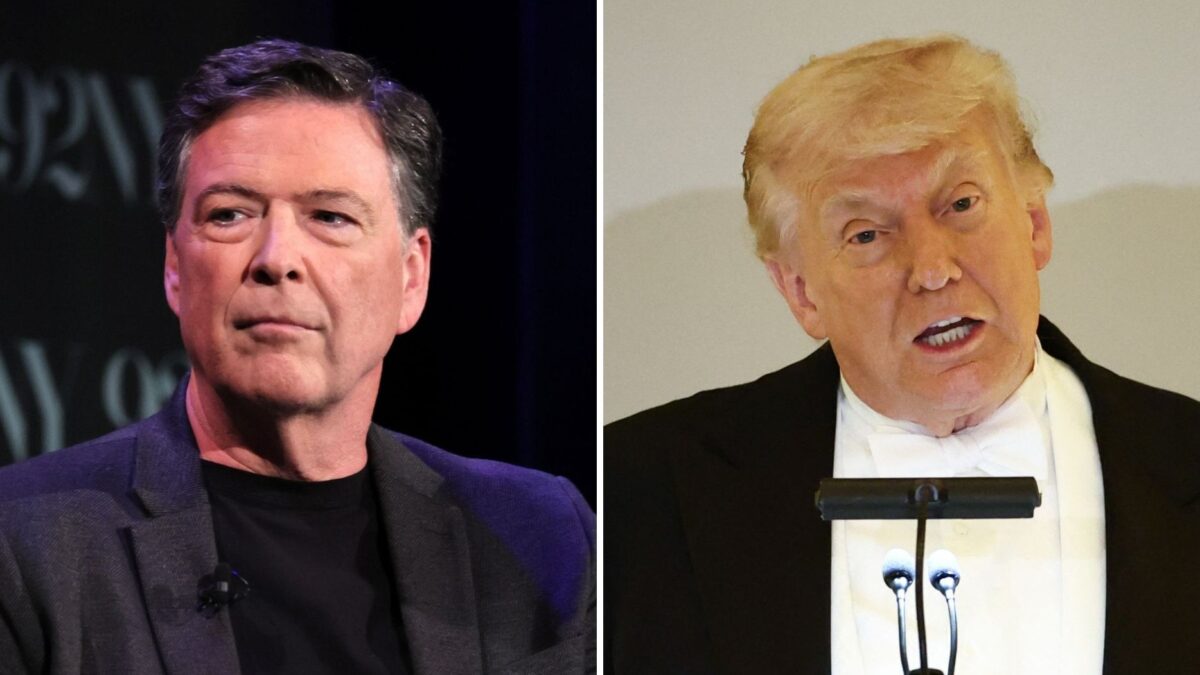
Former FBI Director James Comey, a figure who has long been entwined in political and legal controversies, turned himself in to law enforcement on Wednesday, April 29, following an indictment by the Department of Justice. This time, the charges leveled against him are stark: allegedly threatening the life of President Donald Trump. The case stems from a cryptic image Comey posted on social media featuring seashells spelling out the numbers “86 47.”
- James Comey was indicted on charges of threatening President Donald Trump’s life and transmitting threats in interstate commerce.
- The charges are based on an image of seashells spelling “86 47,” interpreted as a violent threat against Trump.
- Comey denies any malicious intent behind the image and issued an apology before deleting the post.
- Legal experts are divided on whether the Department of Justice’s case holds substantial weight.
- Trump and Comey’s fraught history dates back to the Russian interference investigation during Trump’s first presidential term.
The Alleged Threat: Social Media Post or Misinterpretation?
The controversy began when Comey shared a photo of seashells arranged to spell out “86 47” during a beach walk in North Carolina. While the caption seemed innocuous—”cool shell formation on my beach walk”—the numerical combination drew sharp scrutiny. In slang, “86” can mean to eliminate or kill, while “47” refers to Trump’s position as the 47th President of the United States. The Department of Justice argues that this post constituted a threat against Trump’s life, leading to Comey’s indictment on two counts: threatening the president and transmitting threats in interstate commerce.
Comey quickly removed the post and issued an apology, stating, “I didn’t realize some folks associate those numbers with violence. It never occurred to me, but I oppose violence of any kind so I took the post down.” However, Trump has publicly rejected Comey’s explanation, telling Fox News, “If you’re the FBI director and you don’t know what that meant, that meant assassination.”
Legal Battle Ahead
During his brief appearance in federal court in the Eastern District of Virginia, Comey was not asked to enter a plea. His legal team announced plans to file motions accusing the Department of Justice of pursuing a politically motivated, vindictive prosecution. Legal experts are divided over whether the case against Comey will hold up in court. While the numerical arrangement can be interpreted as a veiled threat, proving intent in such cases often poses significant challenges.
Comey, for his part, appears unfazed. In a video posted to his Substack page, he stated, “I’m still innocent. I’m still not afraid, and I still believe in the independent federal judiciary. So let’s go.” His defiance echoes his response to a previous indictment in 2025, where he was accused of lying to Congress and obstructing a congressional proceeding—charges that were ultimately dismissed due to the prosecutor’s illegal appointment.
A History of Conflict
The strained relationship between Comey and Trump is well-documented. As FBI Director during Trump’s first presidential term, Comey oversaw the bureau’s investigation into alleged Russian interference in the 2016 election. His 2017 congressional testimony revealed that the FBI was exploring potential links between the Trump campaign and Russian operatives. Shortly afterward, Trump fired Comey, citing recommendations from then-Deputy Attorney General Rod Rosenstein and Attorney General Jeff Sessions. The dismissal fueled speculation over whether Trump was attempting to obstruct justice.
Since then, Comey has remained a vocal critic of Trump, publishing books and appearing on media platforms to discuss his views on ethics, leadership, and democracy. Trump, in turn, has consistently portrayed Comey as emblematic of what he calls the “deep state.”
What This Means for You
This case highlights the increasingly polarized landscape of American politics, where even seemingly trivial actions can be weaponized and interpreted as threats. For readers, it serves as a cautionary tale about the power—and risks—of social media. While Comey’s shell arrangement may seem harmless to some, its interpretation underscores how symbolism can take on new meanings in charged political climates.
If you’re active on social media, consider the broader implications of your posts, particularly when discussing public figures or controversial topics. What seems like a benign joke or artistic expression can easily be misconstrued in an age where context is everything. And for those following political news, this case exemplifies how legal systems are increasingly drawn into political battles, leaving room for skepticism about impartiality.
Frequently Asked Questions
Why was James Comey indicted? He was indicted for allegedly threatening President Donald Trump’s life via a social media post featuring seashells spelling out “86 47.”
What does “86 47” mean? In slang, “86” can mean to eliminate or kill, while “47” refers to Trump being the 47th President of the United States.
Will Comey face jail time? If convicted, the charges carry a combined maximum sentence of 10 years. However, proving intent in such cases is often challenging.
What is the history between Comey and Trump? Their relationship has been fraught since Comey oversaw the FBI’s investigation into Russian interference in the 2016 election, leading to his dismissal by Trump.
How has Comey responded to the charges? Comey maintains his innocence and called the prosecution politically motivated. He has vowed to fight the charges.